


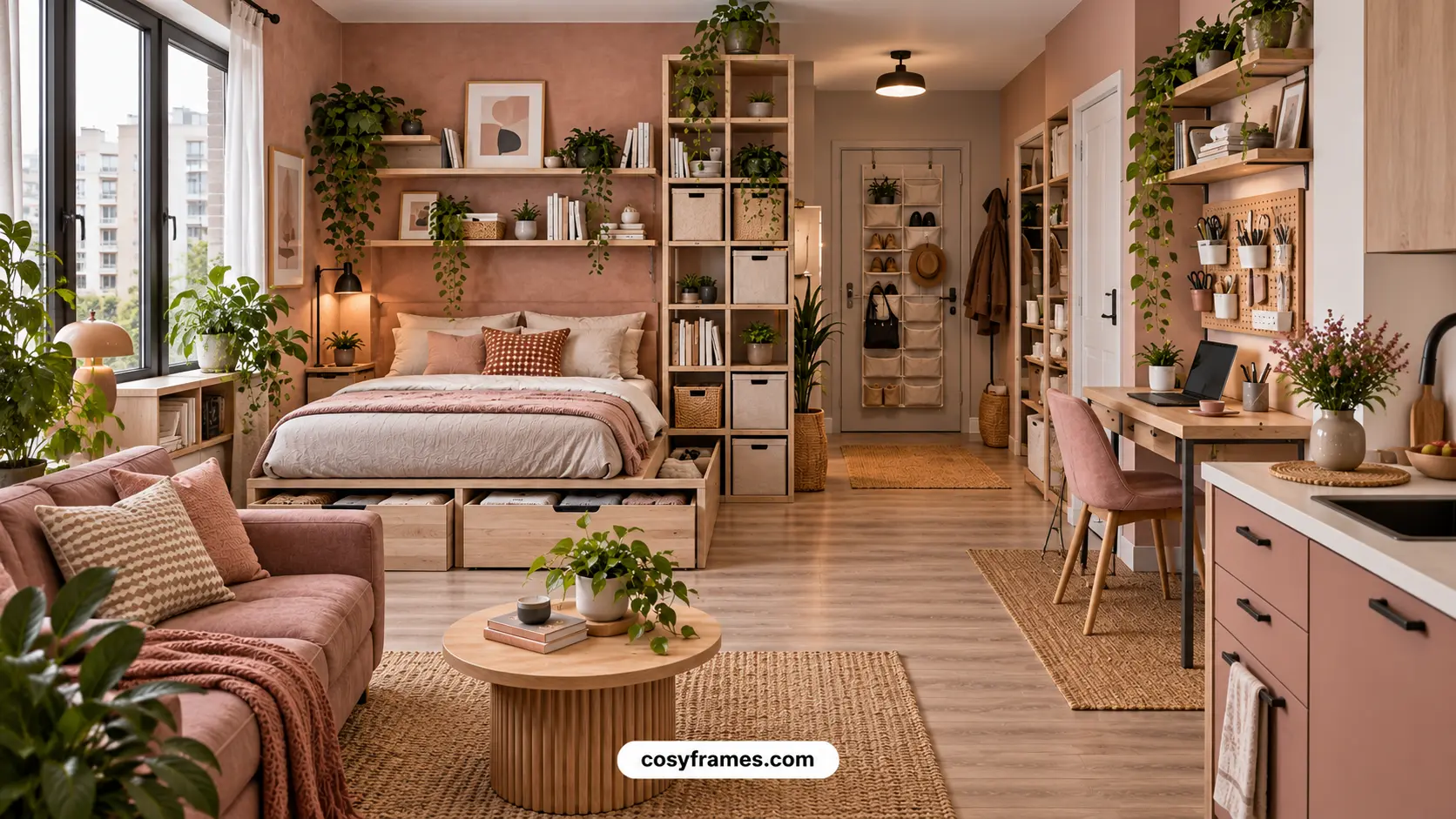
Effective studio apartment storage ideas rely on dividing the single room into functional zones using dual-purpose furniture and vertical shelving. By installing 12-inch deep floor-to-ceiling tension shelves and utilizing bed frames with at least 14 inches of under-bed clearance, renters can double their usable square footage without losing their security deposit.
The Core Rule of Studio Storage: Divide and Store
In a room without walls, your storage furniture must act as the architecture. Placing all your storage against the perimeter walls leaves the center of a studio feeling like a cavernous, unstructured box. By pulling storage units perpendicular to the walls, you create distinct zones for sleeping and living while adding cubic feet of organization.
Using Open-Back Bookcases as Dividers
Opt for a 4×4 or 5×5 cube organizer measuring exactly 15 inches deep to separate your bed from the living area. To maintain natural light flow, leave the top two rows completely open for plants or books. Fill the bottom two or three rows with opaque 13×13-inch fabric or rattan bins to hide cords, seasonal clothing, and paperwork. This creates a visual barrier that functions as a double-sided closet.
Curtained Wardrobe Zones
If your studio lacks a built-in closet, dedicate a 24-inch deep alcove or corner to a freestanding wardrobe system. Install a heavy-duty tension rod across the space, capable of holding up to 30 pounds, and hang a solid-color, ceiling-to-floor curtain (usually 84 to 96 inches long). Behind this curtain, place two freestanding, double-tier garment racks and a 4-drawer plastic chest to mimic a custom walk-in closet without drilling a single hole.
Vertical Studio Apartment Storage Ideas for Renters
Renters often ignore the top 24 inches of their walls out of fear of losing their deposits over drill holes. The solution is utilizing tension-based and over-the-door systems that utilize the entire vertical plane from floor to ceiling.
Tension Pole Shelving Systems
Tension pole shelves, which use spring-loaded poles pressing against the floor and ceiling, are ideal for spaces with 8-foot or 9-foot ceilings. Install a unit with 10-inch or 12-inch deep shelves in a tight bathroom corner or beside your kitchen counter. These systems typically hold 10 to 15 pounds per shelf, providing a sturdy, drill-free home for heavy ceramic mixing bowls, stacks of towels, or pantry dry goods in glass jars.
Over-the-Door Organizers Beyond the Bathroom
Standard 24-pocket clear shoe organizers measure about 22 inches wide and 64 inches long, fitting perfectly over standard interior doors. Do not limit these to the bathroom or closet. Hang one on the inside of your front door to hold umbrellas, standard 16oz water bottles, keys, and reusable grocery bags. Hang another on the inside of a pantry or cabinet door to hold spice jars, measuring tape, and small hand tools.
Double-Duty Furniture Specifications for 400 Square Feet
When you have less than 500 square feet, single-use furniture wastes space. Every piece with a footprint larger than 24×24 inches needs an internal storage compartment.
Bed Frames with Minimum 14-Inch Clearance
The bed is the largest footprint in a studio. A standard 7-inch bed frame clearance barely fits a flattened cardboard box. Upgrade to a 14-inch or 18-inch high metal platform bed frame. A 14-inch clearance allows you to slide four standard 60-quart rolling plastic storage bins (measuring roughly 6 inches high and 34 inches long) underneath, effectively creating the storage capacity of an entire six-drawer dresser.
| Bed Frame Type | Average Clearance Height | Best For Storing | Rental Friendly? |
| Standard Platform | 6 to 8 inches | Vacuum bags, flat shoes | Yes |
| High-Rise Metal Platform | 14 to 18 inches | 60-quart bins, seasonal clothing, luggage | Yes |
| Hydraulic Lift Bed | Full depth of mattress | Ski gear, extra bedding, bulky coats | Yes, but heavy to move |
| Captain’s Bed (Drawers) | Built-in 10-inch drawers | Daily folded clothes, socks, t-shirts | Yes |
Lift-Top Coffee Tables vs. Storage Ottomans
If you work from home, choose a lift-top coffee table measuring at least 36 inches long with a 4-inch to 6-inch deep internal compartment. This hides your laptop, chargers, and notebooks the moment you clock out. If you eat at your desk and prefer open floor space, skip the coffee table entirely and use two 18×18-inch hollow storage ottomans. They serve as a footrest, extra seating for guests, and storage for folded throw blankets.
Maximizing the “Invisible” Storage Zones
Look for the structural gaps in your apartment that are typically ignored. These small pockets yield significant storage when measured and utilized correctly.
The 12-Inch Gap Above Kitchen Cabinets
Most apartment kitchen cabinets stop 12 to 18 inches below the ceiling. Measure the exact height of this gap. Purchase woven baskets or matte plastic bins that are 2 inches shorter than the gap height so they slide in and out easily. Store items you use less than once a month here, such as a 6-quart slow cooker, holiday baking tins, or extra paper towel rolls.
Behind-Sofa Console Storage
If your sofa floats in the middle of the room, you have dead space behind it. Place a 7-inch to 10-inch deep, 30-inch tall console table directly against the back of the sofa. This provides a drop zone for keys and mail on top, while the narrow space underneath can hold three 12-inch tall woven baskets for shoes or recycling.
4. FAQ
How do you maximize storage in a 300 sq ft studio?
Swap a standard bed for an 18-inch high platform frame to fit four 60-quart storage bins underneath, and use a 5×5 cube organizer as a room divider to hold 13×13-inch fabric storage baskets.
Where should I put my clothes in a studio apartment without a closet?
Set up a 48-inch wide freestanding heavy-duty double garment rack in a corner, and conceal it by installing an 84-inch ceiling-mounted curtain track directly in front of it.
How do I store my vacuum in a studio apartment?
Opt for a slim, cordless stick vacuum that comes with a wall mount, and attach it inside the narrow 6-inch gap between your refrigerator and the wall using heavy-duty, renter-friendly adhesive strips.
What is the best way to separate a kitchen from a living room in a studio?
Place a 36-inch high, 15-inch deep freestanding kitchen cart with lockable wheels between the two zones; it provides extra prep space on top and holds heavy pots and pans on its lower shelves.
How can I add storage to my apartment bathroom without drilling?
Place a 24-inch wide over-the-toilet storage rack that uses tension poles between the floor and ceiling; this adds three tiers of 8-inch deep shelving for towels and toiletries.