



Small bedrooms often feel cramped not because of their physical dimensions, but because of poor light distribution and stark visual breaks. Heavy contrasts between baseboards, dark trims, and walls chop up a room, forcing the eye to register hard boundaries. Implementing strategic small bedroom color ideas can create the optical illusion of expansive square footage, higher ceilings, and abundant natural light.
Choosing paint colors for a compact room is about working with light reflection and undertones. Whether you live in a tight studio apartment or want to open up a compact guest room, these 15 designer-tested small bedroom color ideas will help your space feel noticeably larger.
The Optical Physics of Small Bedroom Paint Colors
Before picking up a paintbrush, understanding two core optical principles will guide your color selection:
The Importance of LRV (Light Reflectance Value)
Light Reflectance Value (LRV) measures the percentage of light a paint color reflects on a scale from 0 (pure black) to 100 (pure reflective white). For compact rooms with standard windows, choosing wall colors with an LRV of 62 or higher ensures that ambient light bounces across surfaces, softening dark corners.
Eliminating High-Contrast Visual Breaks
When you paint bright white walls with dark crown molding or stained baseboards, the human eye stops at every trim line, defining the exact perimeter of the room. Using low-contrast color palettes blurs these architectural edges, tricking the brain into perceiving continuous space.
Pro Tip: Wall colors only perform well when paired with appropriate lighting. Explore our bedroom lighting ideas to pair 2700K warm fixtures with your chosen paint shades without creating harsh shadows.
15 Small Bedroom Color Ideas to Visually Expand Your Space
1. Warm Alabaster White for Seamless Daylight Bounce
Unlike stark hospital white, warm alabaster contains subtle cream and biscuit undertones. It maximizes natural daylight reflection while preventing north-facing rooms from looking chilly or flat.
Pro Tip: Keep white rooms from feeling clinical by layering varied natural textures. Check out our cozy neutral bedroom ideas to style alabaster walls with linen and light oak.
2. Whispering Coastal Sage for Natural Depth
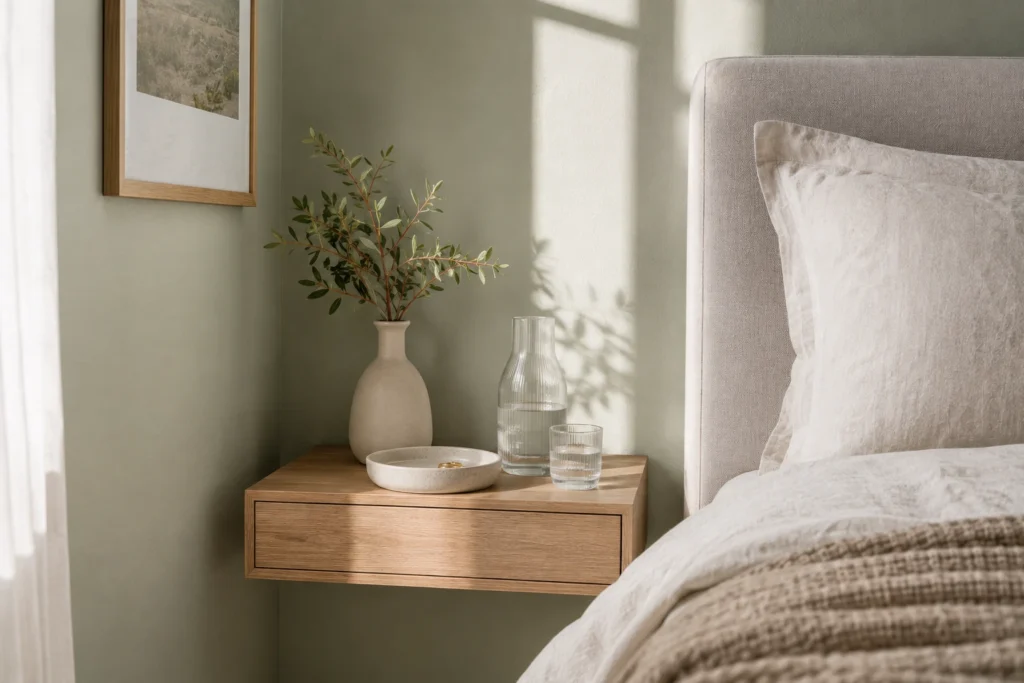
Muted sage green with strong gray undertones behaves like an organic neutral. Because human eyes perceive green hues easily, soft sage pushes wall planes visually outward, making narrow rooms feel deeper.
3. Soft Greige to Blur Corner Boundaries
Greige combines the crispness of gray with the warmth of beige. When testing versatile small bedroom color ideas, greige softens shadowy corners and adapts effortlessly as sunlight shifts from dawn to dusk.
4. Pale Ice Blue to Push Walls Outward
Cool colors physically recede from the eye. A pale ice blue with a touch of silver gray makes walls appear further away than they actually are, creating an airy, open atmosphere.
5. Creamy Oatmeal and Biscuit for Cozy Airiness
Creamy oatmeal gives window-starved rooms a sunlit glow. It provides enough warmth to feel inviting while maintaining a high LRV that prevents the room from closing in.
6. Monochromatic Color Drenching (Walls, Trim, and Ceiling)
One of the most effective small bedroom color ideas is color drenching—painting the walls, baseboards, doors, and ceiling the exact same color in a seamless flat or eggshell finish. This eliminates all visual breaks, extending perceived ceiling height.
Pro Tip: For timeless palette choices suitable for color drenching, explore our bedroom paint color ideas and bedroom color ideas for designer-approved shades.
7. Muted Dove Gray for Crisp Modern Lines
Dove gray with warm silver undertones offers a clean, architectural finish. It provides a soft, non-reflective background that allows slim floating furniture to take center stage.
8. Warm Sand for Sun-Kissed Reflection
Warm sand reflects light with a soft golden hue, making compact apartments feel breezy, spacious, and grounded in natural warmth.
9. Soft Buttercream Yellow to Simulate Morning Sun
In basements or interior bedrooms lacking direct sunlight, a pale buttercream yellow mimics golden morning rays, lifting the room’s energy without visually overwhelming the space.
10. Desaturated Lavender Mist for Optical Height
A gray-infused lavender mist is a sophisticated, subtle hue. Its cool undertones draw the eye upward when used on ceilings, creating the illusion of lofted vertical height.
11. Subtle Linen Taupe for Continuous Horizon
Linen taupe sits between cream and soft brown. It establishes a grounded, unbroken visual horizon that makes furniture footprints appear lighter.
12. Deep Moody Charcoal to Erase Wall Perimeters
While light colors bounce illumination, deep charcoal or slate black works through a different optical principle: it absorbs shadows and blurs where walls end and corners begin, creating an endless, cozy cocoon.
Pro Tip: If you choose dark colors in a small space, pair them with high-end textures. Read our cozy bedroom ideas to balance dark walls with plush bedding and indirect sconces.
13. Pale Mint for Fresh Airy Circulation
A whisper of mint green brings a crisp, refreshing tone to compact rooms. It bounces sunlight effortlessly, keeping tight layouts feeling clean and open.
14. Dusty Blush Pink for Soft Warm Glow
Dusty blush with earthy beige undertones acts as a warm neutral. It catches late afternoon light beautifully, adding a gentle glow that makes tight walls feel soft and spacious.
15. Pure High-Gloss Ceiling with Flat Matte Walls
Pairing matte painted walls with a high-gloss, ultra-light ceiling creates a reflective surface overhead that bounces window light downwards, making standard 8-foot ceilings feel significantly taller.
According to architectural lighting research from the Illuminating Engineering Society, pairing high-reflectance matte wall finishes with balanced ambient luminaires minimizes glare and enhances the perceived volumetric scale of interior rooms.
Strategic Decor Pairing to Maximize Room Scale
Color alone cannot solve layout tightness; it must work together with proportional furnishings:
- Maintain Floor Proportions: Ground your furniture with properly scaled rugs that do not cut off walkways. Consult our bedroom rug size guide to select the right rug dimensions.
- Keep Tabletops Light: Pair light wall colors with slim floating tables. Check our nightstand styling ideas for tips on keeping bedside spaces open.
- Clear Floor Clutter: Maximize storage within furniture and vertical space. Explore our small bedroom storage ideas and small bedroom closet ideas to keep storage zones streamlined.
- Mount Art with Wide Mats: Dress walls using minimalist frames with large white matting. Review our bedroom wall decor ideas for renter-friendly mounting techniques.
Frequently Asked Questions
What paint colors make a small bedroom look bigger?
High-LRV paint colors such as warm alabaster white, pale coastal sage, soft greige, and ice blue reflect maximum daylight and visually push walls outward, making compact rooms feel larger.
Does painting a small bedroom dark make it look smaller?
Not necessarily. While light colors bounce daylight, deep dark colors like charcoal or navy blur wall corners and absorb shadows, creating an infinite, cozy cocoon effect that disguises room boundaries.
Should you paint the ceiling the same color as the walls in a small bedroom?
Yes. Using the color-drenching method by painting the ceiling and walls in the exact same hue removes hard horizontal lines, tricking the eye into perceiving higher ceilings and a more unified space.
What paint finish is best for small bedrooms?
A flat or matte finish on walls is best because it absorbs glare and conceals drywall flaws, while an eggshell finish on trim provides a subtle, washable sheen without creating distracting reflections.