


Looking for a clear bedroom rug size guide? A rug anchors your bedroom, softens your step in the morning, and adds warmth over cold hardwood or plain rental carpet. Choosing the wrong rug size, however, throws off the proportions of the entire room. A rug that is too small looks like a floating postage stamp under a large mattress, while a rug that is too large can swallow your floor space and bunch against baseboards.
Getting the scale right does not require custom measurements or an interior design degree. By pairing your bed frame dimensions with standard rug sizes, you can establish balanced proportions on any budget.
The Golden Rules of Bedroom Rug Placement
Before measuring your floor, keep three structural rules in mind to guide your layout.
The 8-Inch Nightstand Rule
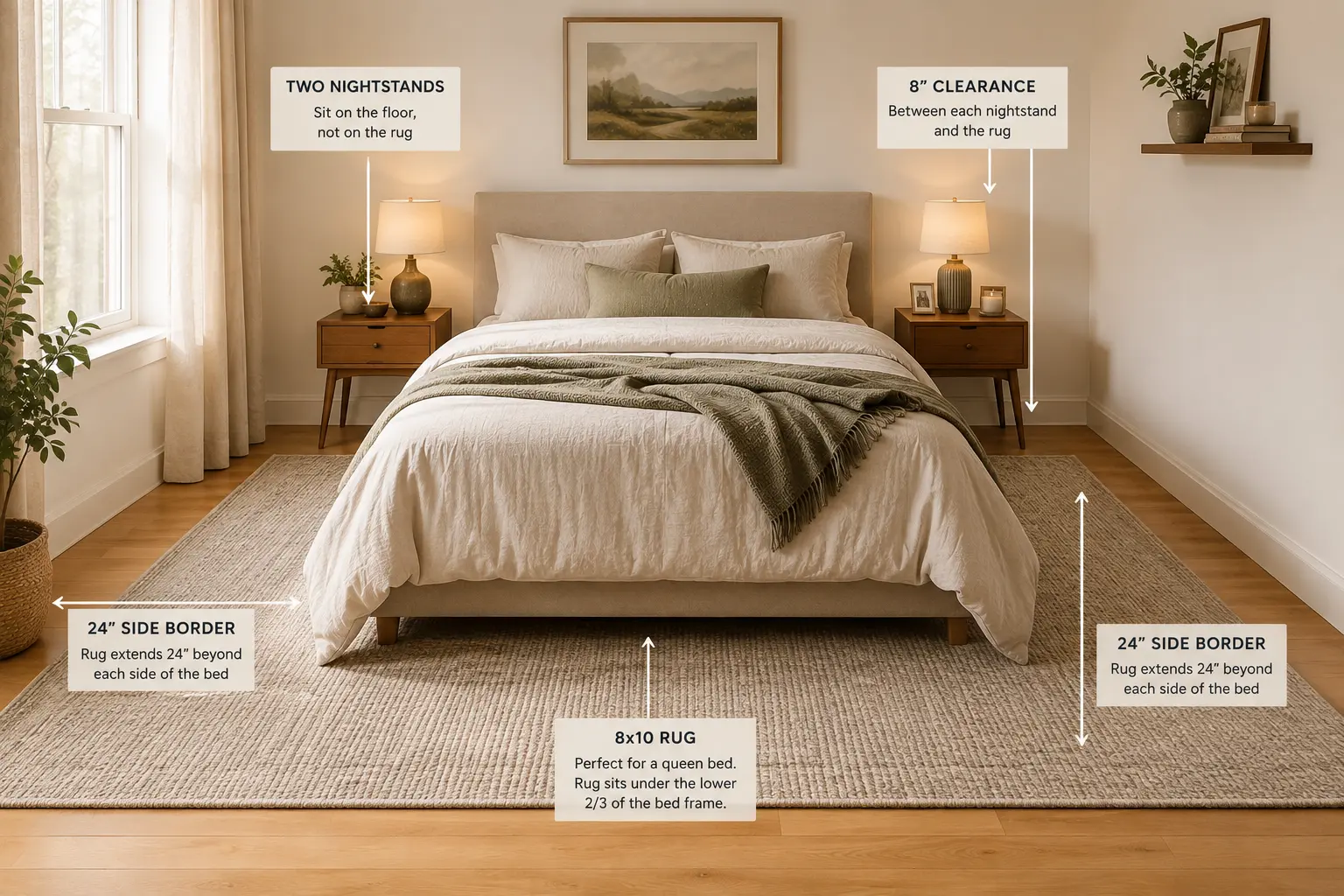
You do not have to place your nightstands entirely on top of the area rug. In fact, in most rental apartments and smaller bedrooms, pushing the rug all the way to the back wall wastes usable rug area under the headboard.
Leave at least 8 inches of bare floor between the back edge of the rug and the front legs of your nightstands. This allows the rug to extend further past the foot of the bed where your feet actually land.
The 18-to-24-Inch Border Rule
To make stepping out of bed comfortable, aim for 18 to 24 inches of rug extending beyond the left, right, and bottom edges of your mattress frame.
- In compact bedrooms, an 18-inch border gives you sufficient floor grip without overwhelming tight walkways.
- In spacious primary suites, a 24-inch border frames larger beds cleanly.
Mind Your Door Clearance and Pile Height
Always measure the clearance between the bottom of your bedroom door (and closet doors) and the floor. High-pile shag rugs frequently jam against standard apartment interior doors. For secondary bedrooms and tight floor plans, stick to flatweaves, low-pile rugs, or low-profile washable rugs with a total thickness under 0.5 inches.
Bedroom Rug Size Guide: Dimensions Chart by Bed Frame
Standard area rugs come in predictable dimensions: 5×8, 6×9, 8×10, 9×12, and runner sizes (typically 2.5×7 to 2.5×10). Match your mattress size to the standard dimensions below.
Rug Sizes for Queen Beds (The Most Common Setup)
A standard queen mattress measures 60 inches wide by 80 inches long (5 feet by 6.6 feet). Because it is the most popular bed size in apartments and homes, you have three clear sizing options depending on room square footage.
8×10 Rug: The Standard Coverage
An 8×10 rug is the standard choice for a queen bed in a room that measures at least 10×12 feet.
- How to place it: Slide the 10-foot width horizontally under the bed, stopping roughly 6 to 8 inches in front of your nightstands.
- The result: You gain roughly 30 inches of soft rug on each side of the mattress and 3 to 4 feet extending past the footboard. This provides plenty of space for a small storage bench at the foot of the bed.
6×9 Rug: The Budget-Friendly Middle Ground
If an 8×10 rug encroaches on your closet doors or air vents, a 6×9 rug offers proportional balance at a lower price point.
- How to place it: Position the 9-foot side horizontally under the lower two-thirds of the queen frame.
- The result: You receive roughly 24 inches of border on each side, which satisfies the standard border rule while leaving your nightstands completely on bare floor.
5×8 Rug: The Lower Two-Thirds Placement
Use a 5×8 rug under a queen bed only if your room is narrow or you are working within a strict budget.
- How to place it: Lay the 8-foot side horizontally, pulling it down so it only anchors the bottom half of the mattress.
- The result: You get approximately 18 inches on each side, but minimal coverage at the foot. This layout prevents a small bedroom from feeling cramped by visible floor borders.
Rug Sizes for King and California King Beds
A standard king mattress is 76 inches wide by 80 inches long (over 6 feet wide), while a California king is 72 inches wide by 84 inches long. Due to the wider footprint, this bedroom rug size guide recommends choosing proportional dimensions so small rugs will not look disconnected under these frames.
9×12 Rug: Full Frame and Nightstand Coverage
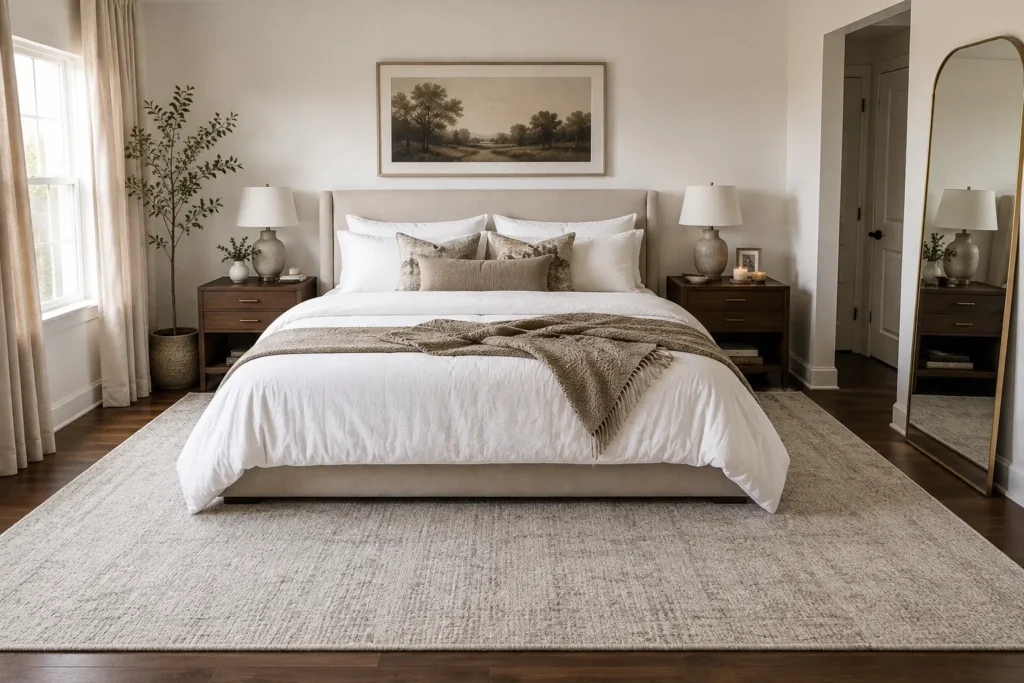
A 9×12 rug is suited for primary bedrooms measuring 12×14 feet or larger.
- How to place it: Place the 12-foot length horizontally. You can slide the rug all the way back so your bed frame, headboard, and both nightstands sit entirely on the rug surface.
- The result: You get approximately 34 inches of rug on both sides of the bed, creating a unified foundation for all your primary bedroom furniture.
According to The Carpet and Rug Institute, maintaining proper pile height helps prolong the life of your bedroom flooring.
8×10 Rug: The Proportional Lower Two-Thirds
If a 9×12 rug covers too much of your flooring, or if you live in a rental with standard bedroom dimensions, an 8×10 rug is the most practical alternative.
- How to place it: Lay the 10-foot width horizontally under the lower two-thirds of the bed frame, leaving the nightstands directly on the floor.
- The result: You get roughly 22 inches of walking space on either side of a standard King bed, keeping the room open while warming the primary step zones.
Rug Sizes for Full and Twin Beds (Small Bedrooms & Guest Rooms)
Full and twin frames fit well in studio apartments, guest rooms, and kids’ bedrooms where square footage is at a premium.
Full Bed Placements (6×9 vs. 5×8)
A full-size bed (54 inches wide by 75 inches long) pairs naturally with a 6×9 rug for generous side coverage (27 inches on each side). If the bedroom is small (under 9×10 feet), choose a 5×8 rug placed under the lower two-thirds to keep at least 12 inches of bare floor between the rug edge and the walls.
Twin Bed Placements (5×8 or Single Runner)
A standard twin mattress measures 38 inches wide.
- 5×8 Rug: Placed horizontally under the bottom half of the bed, a 5×8 rug extends roughly 29 inches past each side, anchoring the frame into the room.
- Single Runner: For tight rental rooms where the bed is pushed against a corner or side wall, skip the large area rug entirely. Place a single 2.5×7 runner along the open side of the bed.
Shared Kids’ Rooms (Two Twin Beds on an 8×10)
When styling two twin beds side-by-side:
- Place one 8×10 rug horizontally across the room.
- Position both twin frames onto the rug with a single shared nightstand between them.
- This connects both beds visually and leaves a comfortable walkway down the middle.
Budget & Rental-Friendly Alternative: Bedroom Runner Rugs
If you are on a tight budget, our bedroom rug size guide suggests using two runners instead.
How to Place Two Runners Alongside the Bed
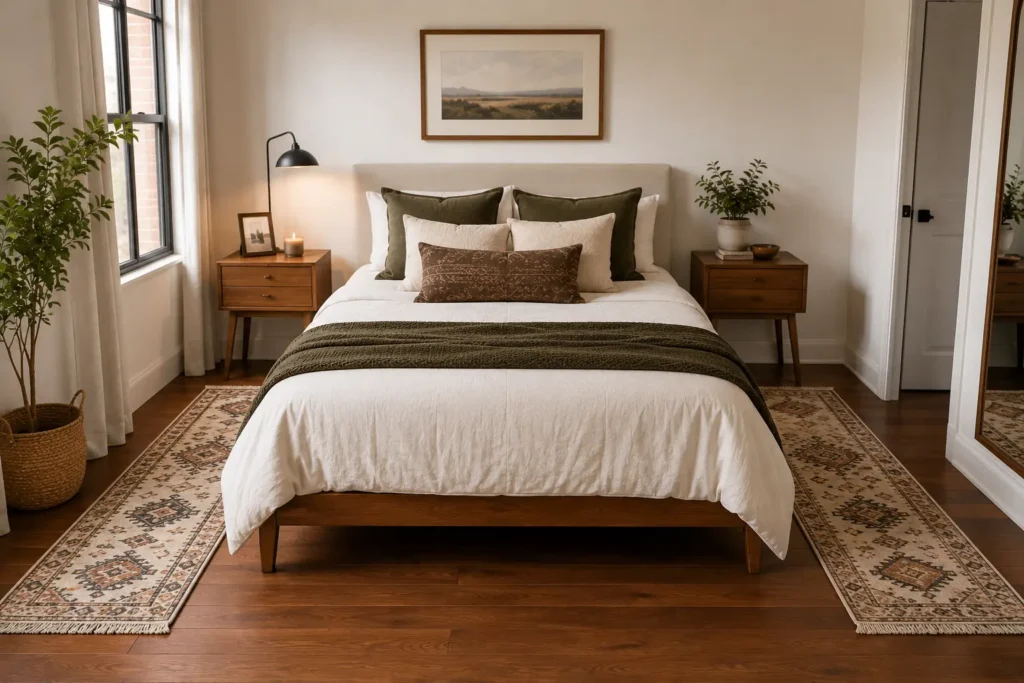
Instead of buying a large area rug that remains mostly hidden beneath your mattress, buy two matching 2.5×7 or 2.5×8 runners.
- Place one runner parallel to the left side of the mattress.
- Place the second runner parallel to the right side of the mattress.
- Keep each runner centered with your normal landing spot when getting out of bed.
- Cost benefit: Two quality runners often cost 40% to 60% less than a single 8×10 rug of the same material, and they fit easily into standard washing machines or moving boxes.
Using a Single Runner at the Foot of the Bed
If your bedroom is long and narrow, place a single runner horizontally across the foot of the bed frame. This adds texture and color to the room’s main walkway without crowding the bedside walkways.
Step-by-Step: How to Measure Your Bedroom Before Buying
Do not rely on visual estimates when ordering rugs online. Measure your exact clearances using this quick layout test.
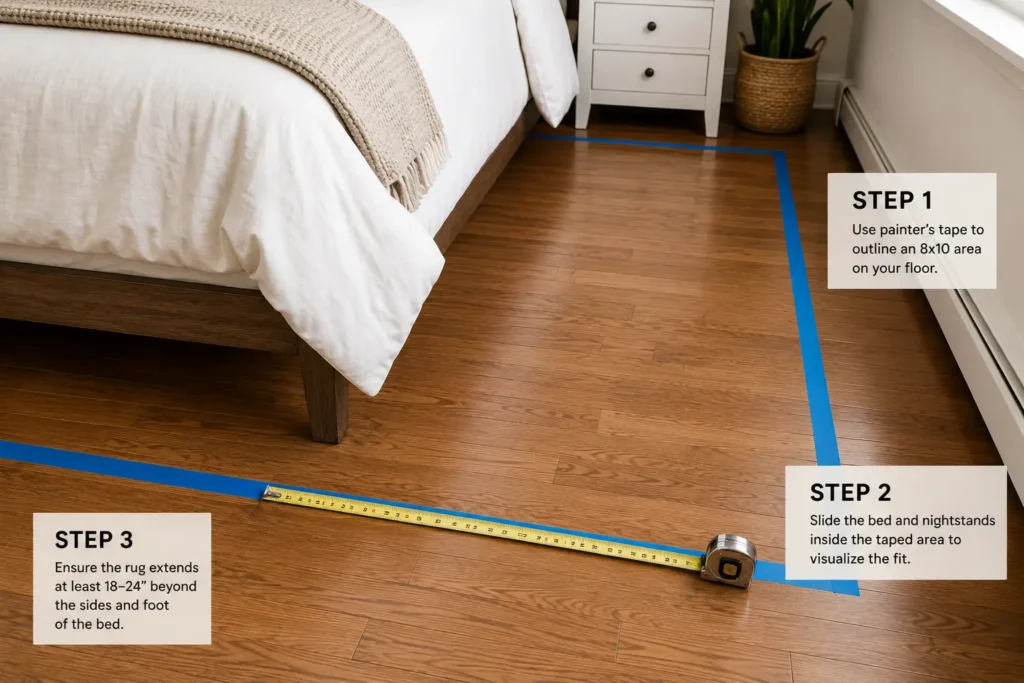
The Painter’s Tape Layout Test
- Clear the floor: Move laundry baskets, storage bins, and clutter away from the perimeter of your bed.
- Mark the corners: Use blue painter’s tape to outline the exact dimensions of the rug size you want to buy (e.g., tape an 8×10 boundary on your floor).
- Check door clearance: Swing your bedroom door, closet doors, and any wardrobe drawers open. If a door passes over the tape outline, measure the floor clearance to ensure a rug will not catch.
- Assess walkway widths: Walk around the perimeter of the bed. Ensure you have at least 18 inches of clearance between the taped border and your dresser, desk, or walls so walkways remain unobstructed.
Practical Buying Considerations for Apartments and Rentals
Selecting the Right Pile Height for Cleaning
- Low-Pile (under 0.25 inches): Easiest to vacuum and vacuum robots traverse them without snagging. Best choice for high-traffic bedrooms and pet owners.
- Medium-Pile (0.25 to 0.5 inches): Offers a softer underfoot feel while fitting under most interior door clearances.
- High-Pile / Shag (over 0.5 inches): Traps dust, hair, and dirt easily. Harder to clean in rentals without a dedicated high-suction vacuum.
Why You Must Use a Rug Pad on Rental Floors
Never place an area rug directly over rental hardwood, luxury vinyl plank (LVP), or carpet without a dedicated pad.
- On hard floors: A dual-surface felt-and-rubber pad prevents slipping, protects delicate wood finishes from rough jute backings, and adds cushioning.
- Over existing wall-to-wall carpet: Use a specialized “carpet-to-carpet” non-slip pad to prevent the area rug from shifting, bunching, or rippling under the bed frame legs.
Washable Rugs vs. Traditional Wool Weaves
- Washable Rugs: Feature a two-piece hook-and-loop system or a thin flatweave profile. They are lightweight, budget-friendly, and convenient for homes with pets or allergies.
- Hand-Tufted or Flatweave Wool: Naturally durable and insulating, but requires spot-cleaning or professional rug cleaning. Opt for wool if soundproofing is your main priority.
4. FAQ SECTION
Frequently Asked Questions
Can a rug be too big for a bedroom?
Yes. If your area rug runs flush against the baseboards or curls up against your walls, it makes the room appear smaller. Always maintain at least 10 to 18 inches of bare floor between the edges of your rug and the room walls to preserve visual balance.
Can I put an area rug over wall-to-wall rental carpet?
Yes. Layering an area rug over standard beige rental carpet helps define the sleeping zone and protects the underlying carpet from spills. Use a firm rug pad designed specifically for carpet layering to prevent the top rug from bunching up.
Should nightstands always sit on the bedroom rug?
No. In most setups, nightstands look natural sitting completely off the rug on bare flooring. As long as the rug starts 6 to 8 inches in front of the nightstand legs, your proportions will look deliberate and balanced.
What size rug do I need for a California King bed?
A 9×12 rug provides full coverage for a California King frame and nightstands. If you want a more budget-friendly layout, an 8×10 rug placed horizontally under the lower two-thirds of the mattress provides 22 inches of extension on both sides.
Here are the most common questions about following a bedroom rug size guide.
How do I clean a large bedroom rug without moving the heavy bed?
For daily maintenance, vacuum the exposed borders around the bed with a standard floor nozzle. For a deeper clean, sprinkle baking soda over the exposed fibers, let it sit for 20 minutes, and vacuum thoroughly. Use a carpet spot-cleaner for localized spills.
Is a 5×8 rug too small for a queen bed?
A 5×8 rug is small for a queen bed if placed conventionally. However, it works well if you place it horizontally under the bottom third of the frame, or in narrow apartment bedrooms where wall clearance is limited.